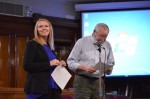
Lots of lessons learned about open meetings, records at Nampa IDOG seminar

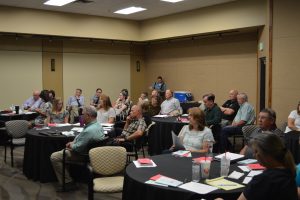
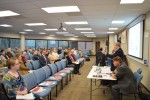
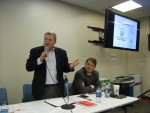
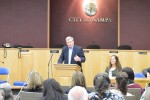
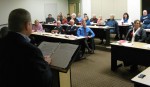
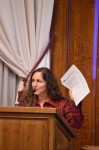
NAMPA, Idaho – It was a cold winter night in Nampa, but more than 75 people filled the Nampa City Hall Council Chambers for an open meeting/public records workshop Jan. 9 led by Idaho Attorney General Lawrence Wasden, along with Deputy Attorney General Brian Kane and IDOG President Betsy Russell.
Attendees ranged from citizens to elected officials, local district secretaries to newspaper reporters, and representatives of the cities of Nampa, Caldwell and Eagle, fire and irrigation districts, school districts, libraries, health districts, the Greater Middleton Parks & Rec Department, the Western Canyon Chronicle, the Messenger Index and more. The Idahoans for Openness in Government seminar was co-sponsored by the Idaho Press-Tribune.

“I learned how to request public records, which will help in my reporting,” wrote a reporter for a small newspaper in her evaluation of the session, adding that she learned, “Tons! This will make doing my job much easier.”

An elected official from a fire district called the session “extremely helpful and totally worth the time to help understand the laws.” Among things he learned that he’ll be able to put to use: “Open meeting laws, executive session rules, and documenting.”

A school board member reported learning, “Subcommittees are supposed to be OPEN,” and noted that is something that will be put to use in the school district.

Another reporter wrote of learning a surprise: “Attorney General Wasden has a sense of humor!” adding that the reporter came away “understanding open meeting laws much better.”

An elected official took away this lesson: “As a government-employed individual, remember everything is public.”

Wrote a citizen: “Every citizen should attend.”

The Nampa session was the 26th IDOG seminar held around the state since they started in 2004; it and the preceding sessions in December in Boise and Payette marked the first time the sessions have returned to the Treasure Valley since 2007.

Just in time for the Nampa seminar and hot off the press were newly updated copies of IDOG’s DVD, “Open Idaho: A User’s Guide to Idaho’s Open Meeting and Public Records Laws.” The DVD, which 35 of the evening’s attendees took home, contains much of the information presented at the seminars; it also includes a version of the interactive skits that audience members helped present at the seminar, presented this time with great flair by actors from the Idaho Shakespeare Festival.

The full content of the “User’s Guide” DVD – plus additional features – is available on IDOG’s website, www.openidaho.org.

The Nampa seminar went late into the evening, due to its 7 p.m. start time. There were lots and lots of questions, but it was all wrapped up by 10 p.m. The later start time for this session was due to legislative activities in Boise the presenters were involved in that day; Kane, for example, was training Idaho’s entire state Legislature on ethics laws for much of the afternoon.

Fortunately for all, a big snowstorm that snarled traffic and made travel conditions hazardous the next morning didn’t hit until long after midnight – well after all session attendees were safe at home.

IDOG’s seminars are funded by a grant from the John S. and James L. Knight Foundation through the National Freedom of Information Coalition. The three Treasure Valley sessions in December and January drew a total of nearly 200 people.

Eye on Boise: Seminars on open meetings, public records draw well

From The Spokesman-Review

More than 230 people throughout North Idaho attended open government seminars last week in Sandpoint, Coeur d’Alene, Moscow and Lewiston. Each of the sessions, sponsored by Idahoans for Openness in Government, was led by Idaho Attorney General Lawrence Wasden, and every attendee got the latest copies of his Idaho Open Meeting Law Manual and his Idaho Public Records Law Manual.

Local and state government officials, reporters and editors, and interested citizens all were invited and turned out in force. “My hope is that even if we are not able to sing in tune, we recognize that there is a sheet of music,” Wasden told the capacity crowd of nearly 100 in Coeur d’Alene.

The attorney general told the group in Moscow that some complain that people who make public records requests are “just fishing.” But, he said, “The public records act is a license to fish.” Public records have to be disclosed to the public.

Deputy Attorney General Brian Kane told the Sandpoint gathering, “Anytime you have a question with the open meeting law … resolve all doubts in favor of openness.”

Led by Wasden, Kane and myself (I’m the president of IDOG, Idahoans for Openness in Government), the sessions included humorous interactive skits that let participants demonstrate some of the requirements of the state’s open meetings and public records laws, along with what to do – and what not to do – to comply. IDOG has held these sessions around Idaho since 2004, and the Lewiston seminar Thursday night was its 23rd. The project is made possible in part by a grant from the John S. and James L. Knight Foundation through the National Freedom of Information Coalition. Partners in the project include the attorney general’s office, the Idaho Press Club, the Association of Idaho Cities and the Idaho Association of Counties.

Co-sponsoring the North Idaho seminars were newspapers throughout the region: the Bonner County Daily Bee in Sandpoint, The Spokesman-Review and Coeur d’Alene Press in Coeur d’Alene, the Moscow-Pullman Daily News in Moscow, and the Lewiston Tribune in Lewiston.

Lewiston Tribune owner A.L. “Butch” Alford, a charter board member of IDOG, told a crowd of 50, “Tonight’s mission is to enlighten the public, government officials from all levels and the press.”

All were well-represented, from city council members to board clerks to reporters and editors to state lawmakers. In their evaluations of the evening session, one reporter wrote, “A terrific review – and enjoyable.” An elected official wrote, “My entity needs to review our open meetings.” Wrote a school board member, “We need to be more careful with email,” adding that her takeaway was, “Don’t stall on public records requests and watch the emails.”

The sessions were an eye-opener for some in the audience, including one participant in Lewiston who has been working with a county task force and realized he may have slipped up on open meeting law requirements. “I MAY be in a hell of a lot of trouble,” he wrote in his evaluation, adding three exclamation points; he conferred directly with Wasden after the session on the steps he should take to make sure he’s in compliance.

Among the points that got a lot of attention:

• The Open Meeting Law says the public can attend the meeting but doesn’t say they can speak or participate; it just guarantees that citizens can observe.

• Emails are public records.

• Agencies can’t take 10 days to decide whether to release a public record in response to a request; that decision has to be made within three days. The law only allows taking up to 10 days to provide the records when it takes longer than the specified three days to locate or retrieve them.

A new law passed this year makes the first two hours of labor and the first 100 pages of copies free of charge in public records requests, excepting only those records for which there’s a separate fee-setting statute, such as records in court files.

“What this means is that 90 percent of your public records requests are going to be free,” Kane told the Sandpoint audience.

Issues covered included recent changes in the law, including a “cure” process for agencies that allows them to acknowledge and correct an open meeting law violation.

“Open meetings and public records are very important to us as a citizenry,” Wasden said. “In order for citizens to be involved, they have to know and understand what their government is doing.”

IDOG likely will hold another session this spring in Boise.

From The Spokesman-Review

Lewiston open government seminar an eye-opener for crowd of 50

From Eye on Boise/Spokesman-Review

At the IDOG open government seminar in Lewiston on Thursday night, A.L. “Butch” Alford, owner of the Lewiston Tribune and a charter board member of IDOG, told a crowd of 50, “Our mission is to foster open government, supervised by an informed and engaged citizenry. We believe we all benefit when the public, the media and government officials are fully aware of the public’s rights to access government information and observe the conduct of the public’s business.” Added Alford, “Tonight’s mission is to enlighten the public, government officials from all levels, and the press.”

All were well-represented in the group that filled a lecture hall at Lewis-Clark State College, from city council members to board clerks to reporters and editors to a state lawmaker. In their evaluations of the evening session, one reporter wrote, “A terrific review – and enjoyable.” An elected official wrote, “My entity needs to review our open meetings.” Wrote a school board member, “We need to be more careful with email,” adding that her takeaway was, “Don’t stall on public records requests and watch the emails.”

The session was an eye-opener for some in the audience, including one who’s been working with a county task force and who realized he may have slipped up on open meeting law requirements. “I MAY be in a hell of a lot of trouble,” he wrote in his evaluation, adding three exclamation points; he conferred directly with Idaho Attorney General Lawrence Wasden after the session on the steps he should take to make sure he’s in compliance.

“Compliance is very critical,” wrote a local government employee in her evaluation. An elected official wrote, “You can work with the law.”

The session focused on the Idaho Open Meeting Law and Public Records Law, what they require and what they don’t, and how everyone can make sure they comply with them. Wasden, who has led all 23 of the IDOG sessions held around the state since 2004, said, “In order for citizens to be involved, they have to know and understand what their government is doing.”

Deputy Attorney General Brian Kane told the group, “The No. 1 goal of the open meeting law is compliance. … If you look at the open meeting law as an entity and say, ‘How can we get around it?’ you’ve defeated the basic purpose – openness.”

Issued covered included recent changes in the law, including a “cure” process for agencies that allows them to correct an open meeting law violation, and new fee provisions for public records that require any labor charges to be clearly itemized and charged at the hourly pay rate of the lowest-paid employee qualified to handle them, and also make, in most cases, the first two hours of labor and 100 pages of copies free.

There’s more information at the IDOG website, www.openidaho.org. IDOG stands for Idahoans for Openness in Government; Wasden’s office partners with the group in the open-government education project, which also is supported by the Idaho Press Club, the Idaho Association of Cities, the Association of Idaho Counties, and receives grant funding from the John S. and James L. Knight Foundation through the National Freedom of Information Coalition. The Lewiston session wrapped up a week-long run of well-attended open government seminars in North Idaho, starting in Sandpoint on Monday and also hitting Coeur d’Alene and Moscow. A Boise session likely will be held this spring.
From Eye on Boise/Spokesman-Review

Moscow crowd learns about open meetings, public records laws

From Eye on Boise/Spokesman-Review

Despite stiff competition – a hard-fought UI basketball game against the Washington State Cougars and the downtown holiday lights parade – nearly 40 people turned out last night for IDOG’s open government seminar in the ornate, wood-paneled, hundred-year-old City Council chambers at Moscow City Hall. Those attending included the mayor, city and county attorneys, reporters and editors, academics and clerks, elected officials, interested citizens and agency staffers who deal with open records and meetings questions daily. The session was co-sponsored by the Moscow-Pullman Daily News.

Attorney General Lawrence Wasden told the group that some might think someone making a public records request is “just fishing.” But, he said, “The public records act is a license to fish.” Public records have to be disclosed to the public.

Deputy Attorney General Brian Kane told the group, “Any time you have a question with the open meeting law … resolve all doubts in favor of openness.”

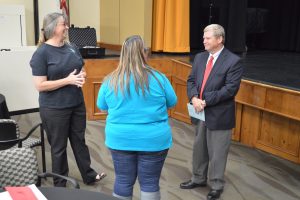
In humorous skits exploring what the public records and open meeting laws require, Moscow City Councilman Walter Steed, shown here, portrayed a lucky reporter – seated next to three county commissioners at a cafe, who are busy illegally conducting the county’s business as he overhears. (The commissioners were portrayed by Kenton Bird of the UI, Moscow City Attorney Randy Fife, and Moscow-Pullman Daily News staffer Kelcie Moseley). The scenario is actually based on a real case in Idaho.

The IDOG seminars move to Lewiston tonight.

From Eye on Boise/Spokesman-Review

Big crowd, lots of interest at CdA open government seminar

From Eye on Boise/Spokesman-Review

A whopping 92 people attended the open government seminar in Coeur d’Alene last night, sponsored by IDOG, Idahoans for Openness in Government, and co-sponsored by the Spokesman-Review and the Coeur d’Alene Press. Press Managing Editor Mike Patrick told the crowd it was the first time he could remember the two competing newspapers co-sponsoring an event. Among those attending were numerous local government officials and staffers, reporters for a variety of news media, political activists, several former state legislators and lots of interested citizens.


Idaho Attorney General Lawrence Wasden singled out an audience member, former state Sen. Gary Ingram, for special recognition: Ingram is the author of much of the Idaho Open Meeting Law, including the key wording in the preamble:

“67-2340. Formation of public policy at open meetings. — The people of the state of Idaho in creating the instruments of government that serve them, do not yield their sovereignty to the agencies so created. Therefore, the legislature finds and declares that it is the policy of this state that the formation of public policy is public business and shall not be conducted in secret.”

Said Wasden, “We owe a great thanks to give to Sen. Ingram for his work on this.”

Also recognized for traveling the farthest to attend: Bannock County Commissioner Howard Manwaring, who traveled from Pocatello to attend the session. It ran well into the evening because the audience had lots of questions, on everything from executive sessions to notice requirements to public records requests to minutes.

In interactive skits to demonstrate various nuances of the open meeting law and the Idaho public records law, actors included Kootenai County Prosecutor Barry McHugh, who portrayed an upset county commission chairman, and Kootenai County Commission Chairman Todd Tondee, who portrayed a county prosecutor. Coeur d’Alene Press reporter Maureen Nolan acted the part of “Trusty the city clerk,” opposite Coeur d’Alene Schools Superintendent Hazel Bauman, playing “Crusty, the reporter.”

Among the comments in the evening’s evaluations: From a school district clerk: “I learned some new information.” From another public employee: “How to keep my entity legal and in compliance.” Another attendee wrote that he learned: “Documents are meant to be public; give public officials a chance to provide them.” Wrote another, “My organization needs to change agenda format and will probably put minutes/agenda online.”

Every attendee got copies of the latest version of the Attorney General’s Open Meeting Law Manual and Public Records Law Manual; both also are online at his website here. Wrote a citizen who attended the Coeur d’Alene seminar, “The booklets will be a great help. There are ways to stay out of ‘trouble.’” Wrote another, “Be cooperative, be helpful, when in doubt check the book.” Tonight, the open government seminar will be in Moscow, and tomorrow, Lewiston; there’s more info here.

From Eye on Boise/Spokesman-Review

Sandpoint turns out for open government seminar

From Eye on Boise/Spokesman-Review

It’s a balmy 28 degrees in Sandpoint this morning, where last night more than 50 people packed the public meeting room at the Sandpoint Library to learn about Idaho’s open meetings and public records laws. “Open meetings and public records are very important to us as a citizenry,” Idaho Attorney General Lawrence Wasden told the group.

It was the first of four North Idaho seminars this week sponsored by Idahoans for Openness in Government, IDOG, in partnership with the Attorney General’s office and recommended by the Idaho Press Club, the Idaho Association of Counties and the Association of Idaho Cities. Last night’s seminar was co-sponsored by the Bonner County Daily Bee; publisher David Keyes said the turnout shows people here really want to know about these issues.

Among the points that got a lot of attention last night: The Open Meeting Law says the public can attend the meeting, but doesn’t say they can speak or participate; it just guarantees that citizens can observe. E-mails are public records. Agencies can’t take 10 days to decide whether or not to release a public record in response to a request; that decision has to be made within three days – the law only allows taking up to 10 days to provide the records when it takes longer than the specified three days to locate or retrieve them. And a new law passed this year makes the first two hours of labor and the first 100 pages of copies free of charge in public records requests, excepting only those records for which there’s a separate fee-setting statute, such as records in court files. “What this means is that 90 percent of your public records requests are going to be free,” Deputy Attorney General Brian Kane told the Sandpoint crowd.

Tonight, it’s on to Coeur d’Alene, where there’s been high interest, followed by Moscow on Wednesday and Lewiston on Thursday. Full disclosure here: I’m the president and a founding board member of IDOG. Last night was IDOG’s 20th open government seminar since 2004, and the first in North Idaho since 2005; Attorney General Wasden has led every seminar. There’s more info, including an online guide to these laws, at www.openidaho.org.

From Eye on Boise/Spokesman-Review

Learning about open records, meetings

May 27, 2010

MOUNTAIN HOME, Idaho — It was a rainy spring evening in Mountain Home, but that didn’t stop a near-capacity crowd of about 50 from filling the Mountain Home Senior Center for a seminar on Idaho’s open meetings and public records laws, complete with Attorney General Lawrence Wasden himself, interactive skits involving lots of audience members, and refreshments afterward.

Elmore County Commissioner Connie Cruser welcomed the crowd, and Wasden, Deputy Attorney General Brian Kane and IDOG President Betsy Russell led the presentation, with plenty of help from audience members who got a chance to portray snoopy reporters, recalcitrant public officials, and others doing things the right way – and the wrong way – under the state’s key openness in government laws.

The session earned top marks from attendees in written evaluations.

“Great overview – where to find answers, who to call,” wrote one elected official who attended; she added, “I appreciated the hands-on, personal approach to this class.”

Bob Cooper of the Idaho Attorney General’s office handled set-up, while the senior center folks had the cookies and punch ready. A banner hung along the wall, stating the preface to Idaho’s Open Meeting Law: “FORMATION OF PUBLIC POLICY AT OPEN MEETINGS. The people of the state of Idaho in creating the instruments of government that serve them, do not yield their sovereignty to the agencies so created. Therefore, the Legislature finds and declares that it is the policy of this state that the formation of public policy is public business and shall not be conducted in secret.”

Every participant in Mountain Home said he or she learned something that could be put to use right away. That included a public official who said he’d “reinforce policy concerning open meeting requirements;” a board clerk listed “posting of notice and agenda;” a citizen wrote “how to interact with government agencies;” and a county employee wrote “correct place to post agendas.”

“I’m more clear about the open meeting laws,” wrote a city zoning administrator. A political candidate gained understanding of the open meeting law and would recommend the seminar to others.

An elected official wrote that his takeaway was this: “Watch what you do very carefully – follow the laws.”

The Mountain Home session was the 23rd such seminar held by IDOG and the Idaho Attorney General since 2004.

Crowd at McCall seminar studies open records, meetings


McCALL, Idaho – More than 60 people gathered for the IDOG open meetings and public records seminar in McCall on May 19, 2010, the 22nd such seminar held around Idaho since 2004.

Those attending ranged from newspaper reporters and editors to city, county, and district elected and appointed officials, staffers for hospitals and fire districts, school officials, emergency responders, clerks, lawyers, political candidates and interested citizens. Leading the seminar were Idaho Attorney General Lawrence Wasden; Deputy Attorney General Brian Kane; and IDOG President Betsy Russell.

Hot topics included “serial” meetings – when public board or commission members contact each other serially to deliberate on an issue rather than gather together, in an effort to evade the Idaho Open Meeting Law – which are violations of the law. Other hot topics: The public’s ability to tape a meeting, which case law says can’t be prohibited if the taping – audio or video – isn’t disruptive of the conduct of the meeting; the fact that email is a public record; and procedures for conducting meetings and responding to public records requests in compliance with the law.

In evaluations of the session, participants gave high marks to interactive skits that cast members of the audience in roles other than their usual ones – a reporter playing a recalcitrant city records clerk, for example, and a public official playing a zealous reporter – while adding a bit of comedy to help bring understanding of the very serious topics covered in the three-hour seminar.

A Planning & Zoning commission chairman who attended the session wrote that among the items learned that could be put into effect immediately were the definition of a serial meeting, and that emails are public records. An elected official wrote of learning “how better to handle our city meetings.” Wrote a citizen who attended, “Thanks for all the booklets!”

All participants were provided with the latest copies of the Attorney General’s open meetings and public records manuals, as well as other manuals on such topics as government ethics.

Everyone filling out evaluations said they’d recommend the seminars, and all said they learned something they could put to use. Receiving rave reviews: The refreshments. The sponsors, McCall Memorial Hospital and The Star-News, provided an array of tempting and creative snacks and sweets.

The seminar was held at the downstairs meeting room of Idaho First Bank in downtown McCall, with a half-hour reception – and a chance to enjoy the outstanding refreshments – preceding the 6 p.m. session.

IDOG bucks World Series

Draws 100+ in Idaho Falls

By Dean Miller

IDAHO FALLS – Reporters and public officials pored over Idaho’s open meetings and open records law together at an Oct. 27 workshop even as the World Series was under way.

Organizers had booked a single meeting room in the Health Sciences building of the Eastern Idaho Technical College and had to call in janitors to move a curtain wall to open up seats for the overflow crowd.

Workshop sponsor Roger Plothow, publisher of the Post Register, noted that he began working on these issues when he was but an Editor and serving as Idaho Press Club President. At that time, in the late 1990s, the Press Club organized a major revision of Idaho laws to protect the public’s right to see government records and attend government meetings.

Plothow expressed happy surprise at the size of the crowd, which included TV and print reporters, dozens of citizen activists and elected state and local officials.

IDOG’s roadshow writers were tickled to observe Post Register reporter Sven Erik Berg in the front row, taking notes shoulder-to-shoulder with Bonneville County Commissioner David Radford. When those two need to work out a public access issue, IDOG’s training ensures they’ll have a shared vocabulary and tools in common with which to address it.

Attorney General Lawrence Wasden reminded participants that his office, which operates as the referee, has observed that both reporters and public officials are wrong about the open meetings, open records act about half the time. Though that would make a great batting average, he said, we can do better. The purpose of the IDOG roadshow is to get people to at least recognize there are standard rules, even if each party reads them slightly differently.

Evaluations from the participants were glowing. The skits, one elected official wrote, were “super,” and the lasting lesson learned: “Assume it’s public unless there’s a specific exemption.” Wrote another: “Great job – better than what I was expecting.” A public employee who attended praised the “pertinent info for my particular job,” and a sewer district board member wrote, “The best thing to do is always have open meetings and only discuss and deliberate there.”

“The info was well covered,” wrote a citizen who attended, while an elected official dubbed it “good preventative medicine.” “We have the tools to maintain our state government’s transparency,” wrote a city attorney. A reporter who attended wrote, “I learned process, order and rights regarding public information.” Wrote another, “I’m a journalist. Now I have a better idea of what I have the right to know. I’ll also be able to differentiate between the truth and getting the run-around.”
Preston seminar draws top reviews

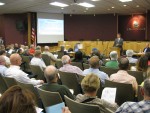
PRESTON, Idaho – “I learned to be a better custodian of public records,” said one state employee who attended the IDOG open meetings and public records seminar in Preston, Idaho on Tuesday, Oct. 30, 2008.

“Great job,” wrote a city clerk, who noted in her evaluation of the session that she learned that the agendas she’s been preparing for city meetings need more information. “I see that I am not specific enough,” she said.

And though the session ran a full three hours – from 6:30 to 9:30 p.m. – one elected official had just one complaint – he’d have liked “a little longer Q & A.”

“I learned a lot,” declared a local appointed board member, who said executive session rules were among the new information.

A county commissioner said he’d gladly recommend the session to others with similar jobs.

And all those who filled out evaluations at the end of the session, held in the Larsen-Sant Public Library in Preston, gave it top marks for the skits, the handouts, the slide show, and for how the session compared to other workshops they’ve attended. Even the refreshments earned top reviews.

Nearly two dozen people attended, and this in a town whose population at the 2000 census was less than 5,000. Preston is the county seat of Franklin County. Located in the far southeastern corner of the state of Idaho, the town gained national fame with the release of the 2004 film “Napoleon Dynamite,” which was filmed and set there and is the hometown of the film’s creators.

For the IDOG seminar, Idaho Attorney General Lawrence Wasden and Deputy Attorney General Bill von Tagen, along with public information officer Bob Cooper, traveled from Boise, and Idaho Falls Post Register Editor Dean Miller traveled from Idaho Falls.